


There are knives that are more than just a tool. They are a piece of memory – of first campfires, of the smell of resin and leather, of the pride of one's first own cutting tool on the belt. The classic Solingen scout knife belongs to this category. Born in the blade city about one hundred years ago, it is a typical German piece of knife history – and still alive today in its modern descendants.
In the PUMA Stories, Jörg Hübner wrote down the history of this type of knife – we are presenting it here from our perspective as PUMA Werk Solingen.
What exactly is a scout knife?
In international usage, knives with a fixed blade, worn in a belt sheath, are called "Sheathknives". They serve a variety of purposes – in some cultures they are simple working tools, in others a status symbol. The scout knives that emerged in Germany about one hundred years ago and were manufactured in Solingen combined both qualities: a practical outdoor tool and at the same time a piece of personal pride on the belt.
They owe their name to the "great journey" – those hikes and excursions that became common after the First World War in organized groups such as the scouts. Worn on the belt, in a leather or metal sheath, the scout knife was ubiquitous there: for preparing meals, for sharpening branches, for making firewood, for crafting small aids in the camp. In short: for everything that belongs to outdoor life.
For a long time, it was also a matter of course within families that adolescents were allowed to own their own knife – for carving in nature or cutting a piece of sausage at a picnic. A piece of educational transfer of responsibility that became tangible with the knife on the belt.
Construction: simple, but stable
The first scout knives were made of pure carbon steel. They were keen cutters, but had to be cared for. Later, stainless counterparts were added, which could also tolerate permanent storage in the leather sheath – without the acid contained in their tanning being able to harm the steel.
As varied as the models were, the basic constructive principle was clear:
- Flat ground blade with a moderate, break-resistant tip
- Guard element between blade and handle
- Hidden full tang that runs completely through the handle
- Handle made of stacked leather discs – layer by layer, tightly pressed
- Aluminum pommel, screwed to the end of the tang with a brass nut
This construction – a handle made of many stacked leather discs, tightly clamped between the guard element and the pommel – is today a hallmark of venerable knife designs under the English term "Stacked Leather". It feels warm and grippy in the hand, looks more beautiful with age, and connects everyone who carries such a knife with a long artisanal tradition.
Variety of shapes – Cowboy and Indian knives
In addition to the "classic" design, there were numerous variants: handles made of staghorn or bakelite, different blade shapes such as Drop Point, Clip Point or unilaterally ground throwing knife models with a centrally located tip. Some models were provided with figural handle finishes, and the associated leather sheaths bore corresponding embossed motifs.
These knives became very popular over time as "Cowboy and Indian knives". They found their way abroad and especially overseas, where they were sold under the name "Scoutknives". Consequently, some American manufacturers produced their own models in various sizes – classics that still enrich the collector's market there today.
Solingen Quality – and its cheap import confusion
As popular as the form was, the temptation to copy it cheaply was great early on. Genuine Solingen brand products must therefore be distinguished from the cheap knives offered for little money in many souvenir shops. While the models from Solingen meet the requirements for material quality and workmanship, the imported goods from the low-budget sector usually consist of inferior material – and the joy of purchase fades at the latest with the first serious use.
Therefore, anyone purchasing a scout knife or a classic sheath knife should pay attention to its origin. A Solingen brand knife is an acquisition for life – and often even beyond, as it is passed down.
A note on history
For historical completeness, it should not be concealed that in the 1920s, in addition to "civilian" scout knives, models were also created that were later issued as part of uniforms to the Hitler Youth during the Nazi dictatorship. These knives were constructively strongly based on bayonets: short tang, plastic handle scales with a diamond pattern, metal sheath. After the war, this design was continued to be produced and marketed under a neutral name. These knives have little in common, constructively or culturally, with the classic Solingen scout knife of the early youth movement – we only mention them here because they are often mixed up in the historical picture.
Where is the classic scout knife today?
In Germany, scout knives with their typical construction have largely gone out of fashion and are only produced by a few Solingen manufacturers. Their tasks have been taken over by modern belt knives for outdoor and leisure use – functionally equivalent, often even superior. However, these modern models no longer possess the special aura of the traditional youth knife that one was allowed to wear on the belt for the first time at the age of 12.
But if you look closely, you will find the old design language alive in our assortment: in knives with stacked leather ring handles, with classic clip and drop point blades, with leather sheaths for wearing on the belt. The DNA of scout knives has not disappeared – it has only evolved.
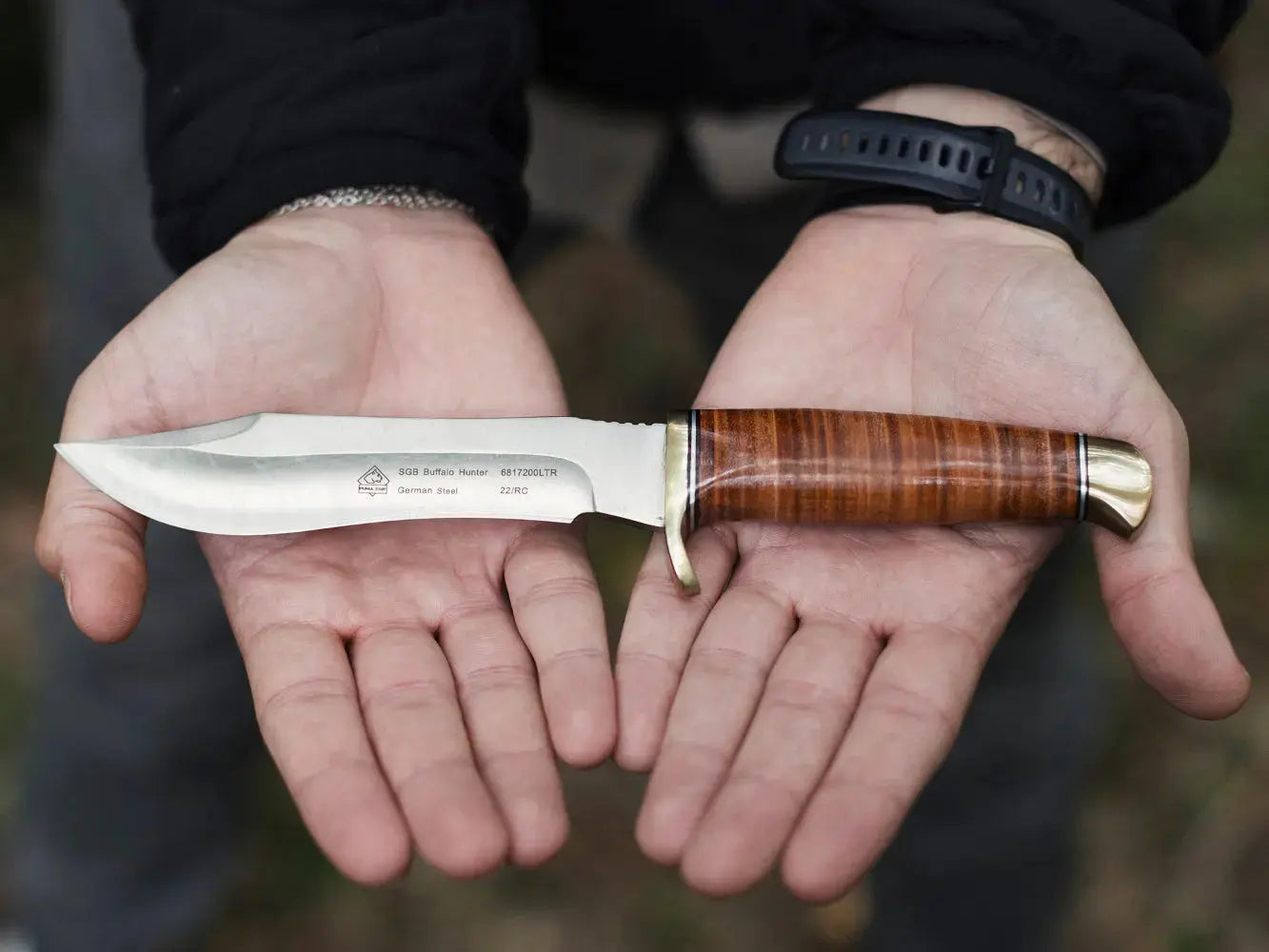
A modern descendant: PUMA SGB Buffalo Hunter, Stacked Leather
One model from our current range naturally continues the essential idea of the classic scout knife: the PUMA SGB Buffalo Hunter, Stacked Leather. Its handle made of stacked cowhide leather – "stacked leather" – exactly adopts the design with which the scout knives of the 1920s accompanied generations of young people: disc by disc, tightly clamped between guard element and pommel, warm and grippy in the hand, becoming more beautiful with each decade.
What makes the Buffalo Hunter a true descendant is precisely this bridge between classic construction and modern blade geometry:
- Clip-point blade with recurve edge – the classic tip of the "Cowboy and Indian knife", combined with a bellied cutting edge geometry that offers more effective cutting length on a compact blade shape.
- Center of gravity shifted forward – more power and impact than with a straight blade, ideal for bushcraft and processing game.
- Easy-care 1.4116 steel, hardened to 55–57 HRC – tough, rust-resistant, easy to resharpen.
- Leather sheath included – as befits a sheath knife in the best tradition.
The leather handle can be cared for as easily as a classic scout knife: occasionally refresh with a little leather grease, clean and dry the blade after use – and the knife will serve for many years.

👉 View PUMA SGB Buffalo Hunter, Stacked Leather in the shop
More than just a tool
A scout knife was never just a tool. It was a companion – on the first hike, at the first self-made campfire, while carving under the watchful eyes of a grandfather. In the blade city of Solingen, we keep this tradition alive with every single, handmade knife. Not out of nostalgia, but because there are tools that can accompany a person for a lifetime – if they are well made.
With thanks to Jörg Hübner for the history of classic Solingen scout knives recorded in the PUMA Stories.