


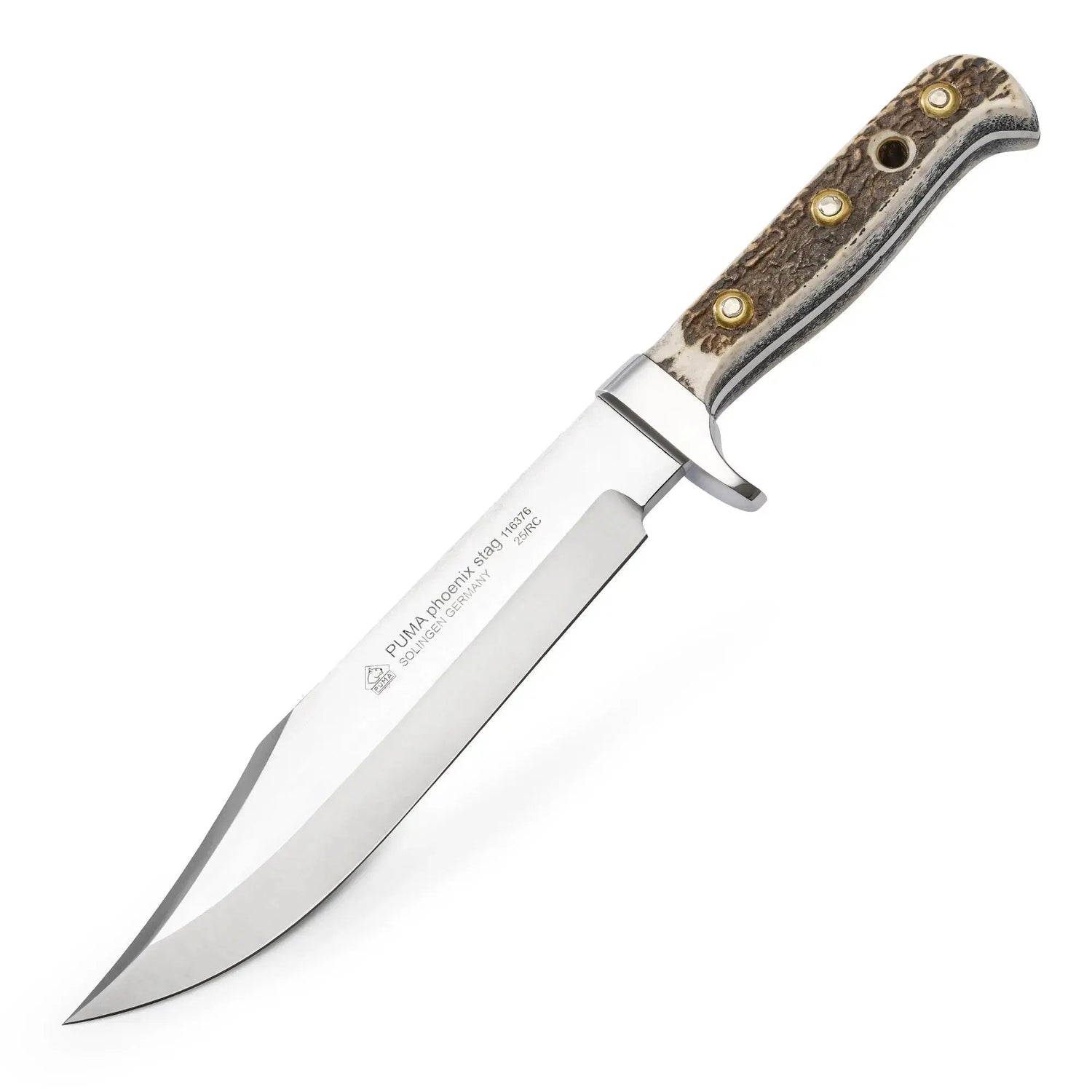
Bowie knives have been part of our product range for decades – now we have reinterpreted the classic with the duckbill blade in three sizes. sedona, tucson and phoenix are the names of the three new Bowie knives from Wupper. Three knives, three main applications, a common Solingen heritage.
This article is based on a report in the PUMA Stories, which Jörg Hübner wrote for us together with Matthias Recktenwald. If you want to read the whole story of our company firsthand, you will find over a hundred pages of concentrated knowledge about our classics in the PUMA Stories.
190 Years of Bowie – and an Original from Solingen
It was almost exactly 190 years ago that a number of feuding individuals got into a bloody dispute on a sandbank in the Mississippi. One of them was the land speculator James Bowie. He fought a spectacular battle with his arch-enemy Major Norris Wright and killed him – even though he was fatally wounded – with a knife. This incident marked the beginning of the myth surrounding the knife wielded by Bowie, which has since been varied many times. There is no end in sight. On the contrary: many bladed weapon manufacturers not only offer this special genre as a sideline in their product range, but are constantly expanding their offerings.
This is also true for us in our traditional knife manufactory in Solingen. We have been building Bowies since knife enthusiasts in Germany became enthusiastic about this American blade shape – and for many of them, our PUMA Original Bowie is still the defining idea of a Bowie knife: It must have looked exactly like that, the famous Bowie knife, as it was once carried in the Wild West.
What makes a Bowie – and what makes our Original different
How "the" Bowie knife should look is still controversial today, given the no longer traceable original form. In the first decades after the sandbank battle, manufacturers in the USA and then those in the British knife capital of Sheffield labeled every larger knife type with the sales-driving Scottish family name Bowie. Eventually, however, the elements that are considered typical for Bowies today emerged: the blade with the duckbill or pike shape (English: Clip Point Blade) and a symmetrically constructed handle with a guard, i.e. a handguard that protrudes both upwards and downwards. Thus, the classic Bowie Knife combines elements of a dagger and a knife – according to bladed weapon nomenclature, it is a dagger knife.
Exactly that is not our PUMA Original Bowie: An asymmetrical, canoe-shaped handle, a handguard with only one bar, and an asymmetrical blade make this version a purebred knife. It was created after the Second World War, when Oswald von Frankenberg und Ludwigsdorf joined our company, whose beginnings, according to J. Anthony Carter's fundamental work "German Knife and Sword Makers", date back to 1769. From 1953, Frankenberg reorganized our company – focusing on high-quality hunting, fishing, and outdoor knives.
Precisely at this time, the US adventure film "The Iron Mistress" starring Alan Ladd as Jim Bowie caused the first major knife boom of the second half of the 20th century – and with it an increased demand for Bowie knives. With a view to recognizability within our range, the PUMA Original Bowie received its characteristic handle shape, the tang of which is typically covered with riveted stag horn scales for our company. Also unmistakable is the corresponding leather sheath for our Bowie with its straight outer contour, the double seam row with its four rivets, the leg strap, the snap fastener, and the securing loop for the pommel.
Three new models – Arizona city names
We have now reinterpreted this very knife. All three new products share the same typical Bowie shape, an aluminum bolster, and riveted handle scales. Differences exist in size, steel type, and manufacturing method. And although Jim Bowie is considered a Texan legend, we decided to name our new creations after cities in Arizona – namely sedona, tucson, and phoenix. This may seem surprising at first glance, but it is quite consistent given the early spread of this type of knife beyond national borders.
PUMA sedona – the compact version
The most compact version of the trio. We laser-cut the blade and tang from a single piece of DIN 1.4125 steel. It measures 138 mm and is 3.8 mm thick. The PUMA sedona measures 255 mm in total and weighs 170 grams. The riveted handle scales are made of ebony; a perfectly fitting belt sheath made of saddle leather is included, as with all three models.
The Sedona is excellently suited for users with small to medium-sized hands. Its purpose ranges from outdoor activities to tracking and dispatching, as well as dressing game. Anyone looking for a beautiful, lightweight, and not too large fixed-blade knife for daily cutting tasks should be very happy with the Sedona.
PUMA tucson – the direct relative of the Original Bowie
Slightly larger and stronger than the Sedona. The blade length of the PUMA tucson is 165 mm, and the back thickness is 4.0 mm. Also laser-cut from 1.4125 steel, with ebony scales, it weighs around 200 grams with an overall dimension of 279 mm. The handle is no longer than that of its smaller brother but has slightly thicker handle scales.
The Tucson is almost identical in construction to our PUMA Original Bowie (116396), which is still in our range – apart from its classic stag horn handle scales. In terms of application, it is largely identical to that of the Sedona.
PUMA phoenix – the massive flagship
With a length of 327 mm and a weight of over 400 grams, the Phoenix is the largest and, above all, most massive knife in the trio. The blade measures 200 mm and has a substantial 7 mm thick spine. The PUMA phoenix differs from the other two models in several respects: The blade is not laser-cut but forged, and it is made not of 1.4125 steel but of 1.4116 steel. For the handle scales, you can choose between ebony and a version with stag horn scales – the PUMA phoenix, stag.
Even very large hands will find enough space here, although users with small hands might reach their limits, at least with the stag horn handle (which is particularly voluminous). Dimensions and weight invite hard use. The Phoenix is equally well suited for outdoor activities as it is for accompanying hunters. We have tailored the matching leather sheath for the Phoenix (Bowie XL) to the format of its big brother.
Why two different steels?
Our decision to proceed differently with the Sedona and Tucson on the one hand and the Phoenix on the other is due to their different intended uses. The steel according to DIN 1.4125 (corresponding to American 440 C) is an excellent choice for pure cutting tasks. With its hardness of 57 to 60 HRC and its relatively high carbon and chromium content, it is extremely edge-retaining and ideally suited for the assigned applications.
The massive Phoenix, on the other hand, is also designed for powerful blows and generally for tougher tasks. That's why we chose DIN 1.4116 steel, hardened to a moderate 55 to 57 HRC. This steel has slightly less carbon and chromium, is therefore finer-grained in structure, and thus less prone to breakage when things get rough. Drop forging does the rest and makes the Phoenix a knife for all eventualities.
Solingen Craftsmanship – The Bowie Trio at a glance
PUMA sedona – the compact version with a 138 mm blade, laser-cut from 1.4125, ebony handle scales, lightweight at 170 g. Ideal for daily cutting tasks and users with small to medium hands.
PUMA tucson – the medium model with a 165 mm blade, also laser-cut from 1.4125 and ebony handle scales. The direct relative of our Original Bowie.
PUMA phoenix – the forged flagship with a 200 mm blade from 1.4116, 7 mm spine thickness, over 400 g, in ebony or stag horn (phoenix, stag).


👉 View PUMA sedona in the shop
👉 View PUMA tucson in the shop
👉 View PUMA phoenix (ebony) in the shop
👉 View PUMA phoenix, stag (staghorn) in the shop
👉 View PUMA Original Bowie (116396) in the shop
The Bowie family from our house – further models
Anyone who is enthusiastic about the Bowie blade shape will find a whole range of other models in our product range – both from our Solingen factory and from the SGB line of our overseas representative PUMA Knife Company USA, which continues our American roots in a special way.
Bowie classics from Solingen:
PUMA IP el anta – The elk gives this PUMA IP model its name. The 28.5 cm long knife with its almost 16 cm long, Bowie-like blade looks massive – a true classic for hunting and outdoor use.
Bowie models from the PUMA SGB line:
PUMA SGB big bear bowie, G10 black – The distinctive "Big Bear" Bowie with durable G10 handle scales in matte black.
PUMA SGB big bear bowie, staghorn – The same massive Big Bear, in the elegant staghorn version.
PUMA SGB big bear bowie, olive wood – With warmly grained olive wood handle scales and mosaic pins.
PUMA SGB big bear bowie, Jacaranda Wood – With characterful Jacaranda handle scales.
PUMA SGB bowie, Jacaranda wood – The slimmer SGB Bowie variant with Jacaranda wood.
PUMA SGB Bowie / Whitetail, POM Commando Stag – The combination of a robust Bowie and a reliable folding knife – both cutting tools with POM Commando Stag handle scales for every venture.
Who are our Bowies for?
Our three new Bowie knives – sedona, tucson, and phoenix – are aimed at anyone who appreciates this iconic blade shape and needs different sizes for different tasks. The sedona is a lightweight, beautifully designed all-rounder for daily cutting tasks. The tucson offers a bit more substance and is a direct descendant of the Original Bowie. The phoenix is the statement piece – a massive knife for serious outdoor and hunting tasks that can also handle heavy use.
All three have one thing in common: they are manufactured in our factory in Solingen and stand in a tradition that dates back to 1769. That this tradition is also cultivated where the Bowie knife was once born is shown by our American sister brand PUMA Knife Company USA with its diverse SGB Bowie line – there, we continue the American roots of the Bowie in our own way.
With thanks to Matthias Recktenwald and Jörg Hübner for the detailed report in the PUMA Stories.