


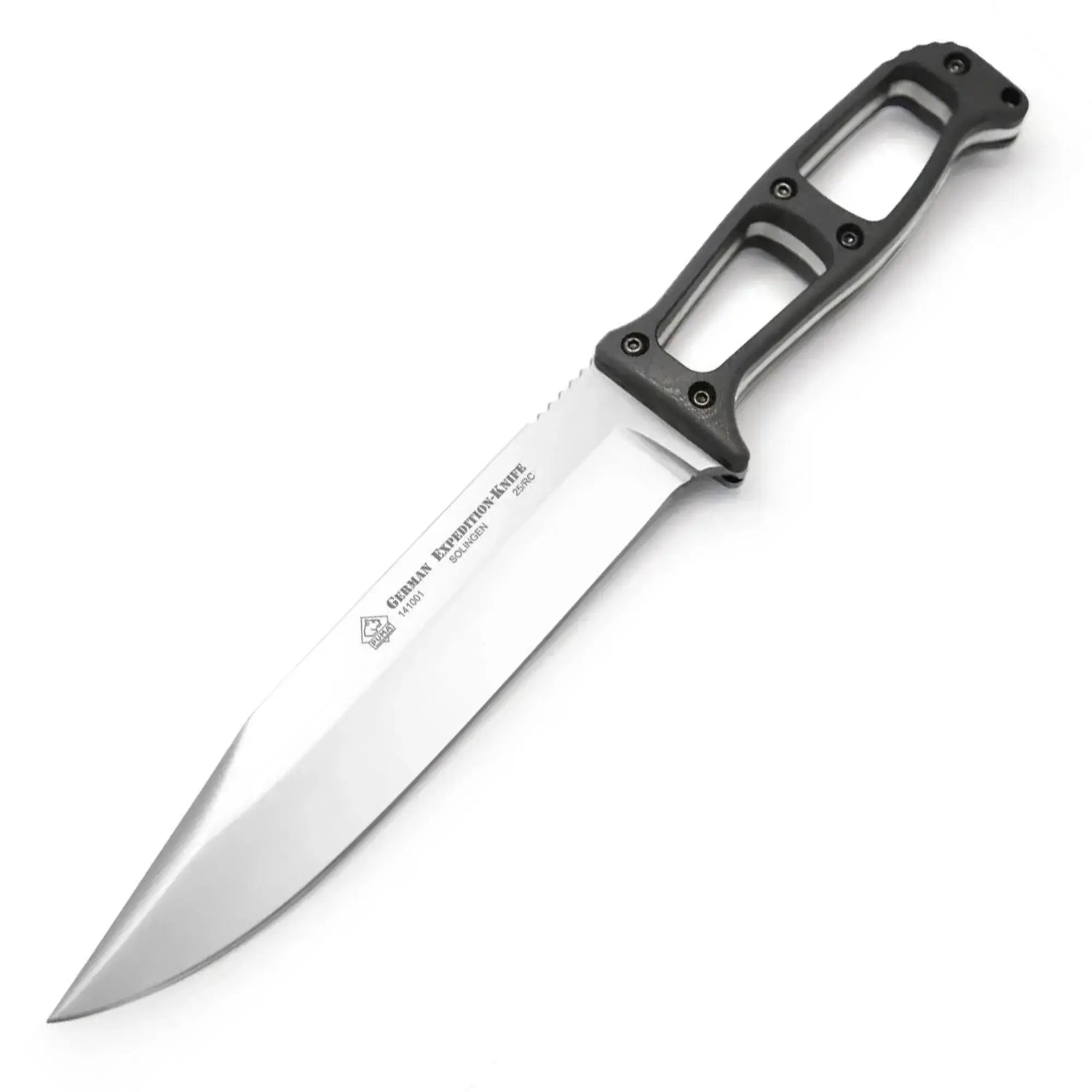
There are knives you buy. And there are knives that emerge from an idea, because their designer actually used them in the wilderness. The PUMA GEK – German Expedition Knife falls into the second category. More than thirty years ago, Anton "Tony" Lennartz translated his experiences from the Canadian Rocky Mountains, from Sweden, and from countless survival seminars into a single tool. We have been manufacturing this knife in our Solingen factory since 1992.
Jörg Hübner dedicated one of his finest articles to the GEK in PUMA Stories – "A Man and His Knife". We reproduce his story here in our own words, with original quotes from Tony Lennartz and an explanation of why this classic still comes from our workshop today.
From Survival Professional to Knife Designer
Many knife enthusiasts create sketches in which they imagine their ideal knife. But it is rare for such a design to actually go into series production. This is exactly what happened with the German Expedition Knife – and for good reason. Anton J. Lennartz is no ordinary knife enthusiast. He dedicated himself to life in nature as early as 1968, studied the hunter-gatherer cultures of the northern hemisphere, and taught survival courses in Sweden, the Eifel, and the Belgian Ardennes in the 1970s.
He lived for several months in the Canadian Rocky Mountains – a place he still returns to repeatedly to travel the land with the Cree Indians and learn about their culture. In Belgium, where he lives today, he founded the Society of Northamerican Native Culture, an association for the preservation of the traditional culture and way of life of the North American Indians. This spiritual way of thinking has deeply shaped Tony's relationship with nature – and thus every one of his knife designs.
A Simple Philosophy
Tony Lennartz translated his experiences into a design in the late 1980s. His design philosophy is so clear that it can be summarized in one sentence:
This idea runs through every detail of the GEK. It is not a specialist – it is a generalist with a clear mission: to function in the wilderness when you can only rely on one tool. Chopping, cutting, carving, stabbing, providing, making firewood, building emergency shelters – all this should be possible with a single knife.
The Construction – Every Detail Has a Reason
Tony uncompromisingly tailored his expedition knife for use in nature. The blade is 17.5 cm long – based on his experience, the ideal size for an all-rounder in the wilderness. The shape is reminiscent of a classic Bowie knife, but with a crucial special feature: The tip lies exactly in the middle in the extension of the handle axis. This means that when thrusting, the force is not deflected sideways.
The grind on the front of the blade spine makes it easier to penetrate hard materials. The flat grind makes the knife more stable than a hollow grind because more material supports the cutting edge. Tony deliberately omitted a false edge – the dull area between the cutting edge and the handle.
The blade spine is 5 mm thick and deliberately wide and flat – not thinly ground, not sawed. The reason: This surface is excellent for working with a baton ("batoning") when wood needs to be split. A serration at this point would only interfere.
The Handle – Inspired by the Machete
The shape of the GEK's handle is reminiscent of a South American machete – and that's no coincidence. The downward-curved pommel prevents the knife from slipping out of the hand when chopping. The handguard at the front ensures that the hand does not slide onto the cutting edge.
A special feature that distinguishes the GEK from many other knives: The handle is designed as a hollow bow. There are no handle scales that could warp or loosen. Blade and handle are forged from a single piece of steel – maximum stability through minimal complexity. Cleaning is therefore incredibly easy.
But the openings in the handle are more than just a cleaning advantage. Ropes and cords can be passed through them – either as a lanyard or, in an emergency, to tie the knife to a stick and use it as an improvised spear. In the wilderness, precisely this detail can make a difference.
The Steel – Resharpenable Instead of Extremely Hard
When choosing steel, Tony follows a pragmatic logic that we share in our workshop:
For the GEK from our Solingen production, we use the stainless steel 1.4116 (X45CrMoV15). It offers exactly the balance Tony demands: corrosion-resistant enough for long tours in humid environments, hard enough for long edge retention, but not so hard that the blade would break under extreme stress. In the wilderness, a bent blade is a problem – a broken one can become a catastrophe.
From Bankruptcy to Classic – How the GEK Came to PUMA
The story of how the expedition knife came to us in Solingen is almost cinematic. Tony originally had his knife manufactured by the Solingen company Carl Schlieper – production ran there for two years. But in the early 1990s, Schlieper had to file for bankruptcy.
Tony reacted quickly: He bought the forging tools specially made for the expedition knife from the insolvency administrator. With these tools under his arm, he knocked on the door of our PUMA factory – and we gladly let him in. Since 1992, we have been manufacturing the German Expedition Knife in Solingen. The design has sold all over the world and has proven itself excellently in practice – on expeditions, with bushcrafters, in hunting, and of course in Tony's own survival courses.
The Europa Knife – The Little Brother
In the meantime, a smaller version called the Europa Knife has also been produced in our factory. It has the same construction principle as the GEK, but is much more compact with a blade length of 9.5 cm. Strongly pronounced finger grooves also ensure very good grip – ideal for finer work or as an urban companion.
Today, the Europa Knife is primarily available through collectors, as we no longer produce it in regular series. However, the original idea – a compact companion with the same design philosophy – lives on to this day in other models designed by Tony, first and foremost in the new PUMA PARA, EDC Steel.
Who is the GEK Made For?
The German Expedition Knife is not a showpiece for the display case – although as a classic it is also found in many collections. It is a tool for all those who truly go out into nature: bushcrafters, hunters, survival instructors, wilderness trekkers, outdoor educators. If you want to know what the knife can do, you should imagine what Tony himself does with it – for over three decades, from the Belgian forest to the Canadian Rocky Mountains.
The large expedition knife and the small Europa knife have complemented each other over the years:
Solingen Craftsmanship – The GEK Today
We manufacture the PUMA GEK in our factory in Solingen – with the same forging tools that Tony rescued from the insolvency administrator at the time. The current version is a carefully modified variant of the original: same geometry, same philosophy, same steel type, with minor improvements in workmanship and sheath.

Technical data at a glance
- Blade length: approx. 175 mm
- Blade thickness: 5 mm
- Steel: 1.4116 (X45CrMoV15), stainless
- Construction: Blade and handle forged from one piece, hollow bow handle
- Grind: Flat grind, without false edge
- Design: Anton "Tony" Lennartz
- Made: Solingen, Germany (since 1992)
👉 View PUMA GEK, German Expedition Knife in the shop
More Knives by Tony Lennartz
The GEK was the beginning of a long collaboration between Tony Lennartz and our factory in Solingen. If you want to be convinced by his design philosophy, you will find several models from his pen in our range today – each with its own focus of application:
PUMA Robuster, Micarta – Tony's latest design, conceived as a tool for precisely those situations where the GEK reaches its physical limits. More robust, heavier, with a quiver sheath and Micarta handle.
PUMA Robuster, Walnut Wood – The same construction as the Micarta Robuster, but with warm-grained walnut as a classic wood variant.
PUMA PARA, EDC Steel – The compact EDC knife made of Böhler N690, continuously numbered. Tony's design principles for everyday use or as a backup on the belt.
Thanks to Jörg Hübner for the detailed report in the PUMA Stories and to Tony Lennartz for the tireless design work that has shaped German outdoor knife craftsmanship for more than three decades.