



Customers also bought

PUMA "Evolution" set

Item No.: 382020
EAN: 4046581820206

Product description
The Evolution of Knives: The eventful history of mankind is inextricably linked with the development of cutting tools. Due to the different developments of peoples, the transitions between the "Stone, Bronze and Iron Ages" are fluid and staggered in time. However, bladed weapons found their way into every culture and often served, often with elaborate ornamentation, as status symbols for their owners. From the very beginning, it was vital to possess tools with which to produce food and clothing. This required butchering hunted game and processing its components. Our ancestors initially used sharp-edged stones for this purpose.
By shaping flints, the first "knife" was then produced: the hand axe. This could be used for cutting, scraping, dismembering, sharpening, and as a weapon. Man had thus reached an evolutionary stage in which he could purposefully use a self-made tool.
In further development, humans succeeded in extracting and processing metals. Copper was first used for knife making. This could be cast into molds by heating and then processed. This new melting process made it possible to produce complex shapes, so that blades and handles could form an integral unit. However, the cutting tools were not hard and robust enough to perform all the necessary work, and so stone tools continued to be used.
In the subsequent period, however, it was possible to add some tin to copper to produce bronze. This now had excellent properties and thus completely replaced stone as a blade material. The melting and smelting of iron ore finally led to the production of iron and later - by adding carbon - of steel. The compaction and achievable hardness of the material could be controlled by forging and subsequent heat treatment, so that wear resistance and durability were optimized. Now longer blades, for example for swords, could also be produced, which showed both hardness and flexibility.
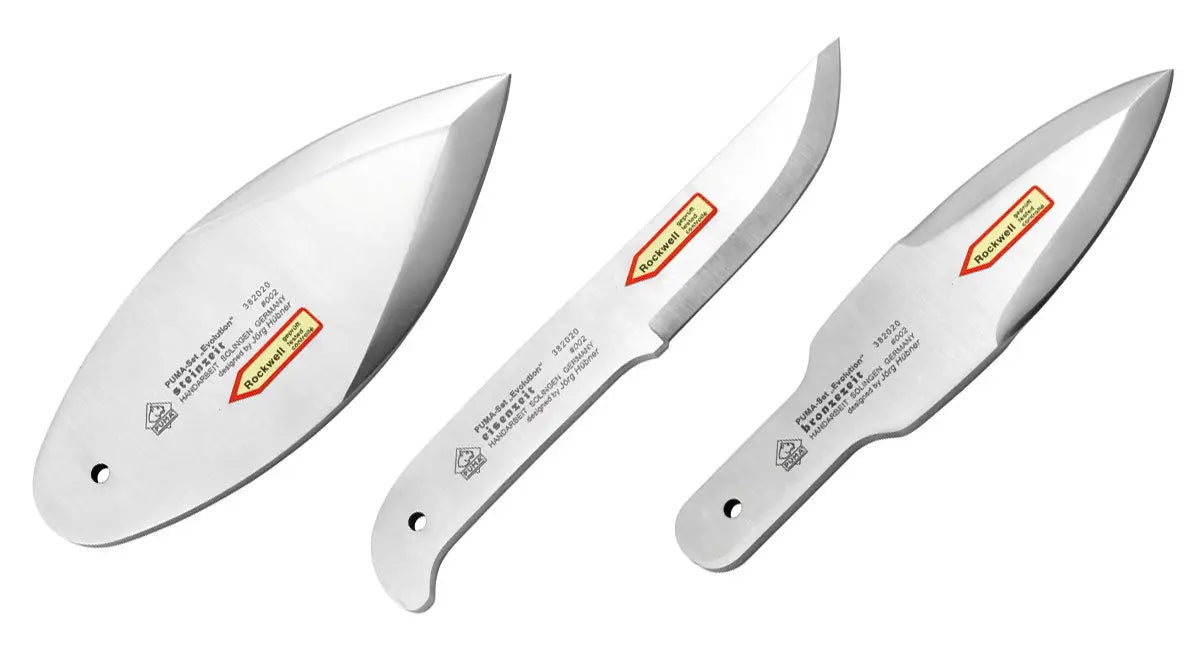
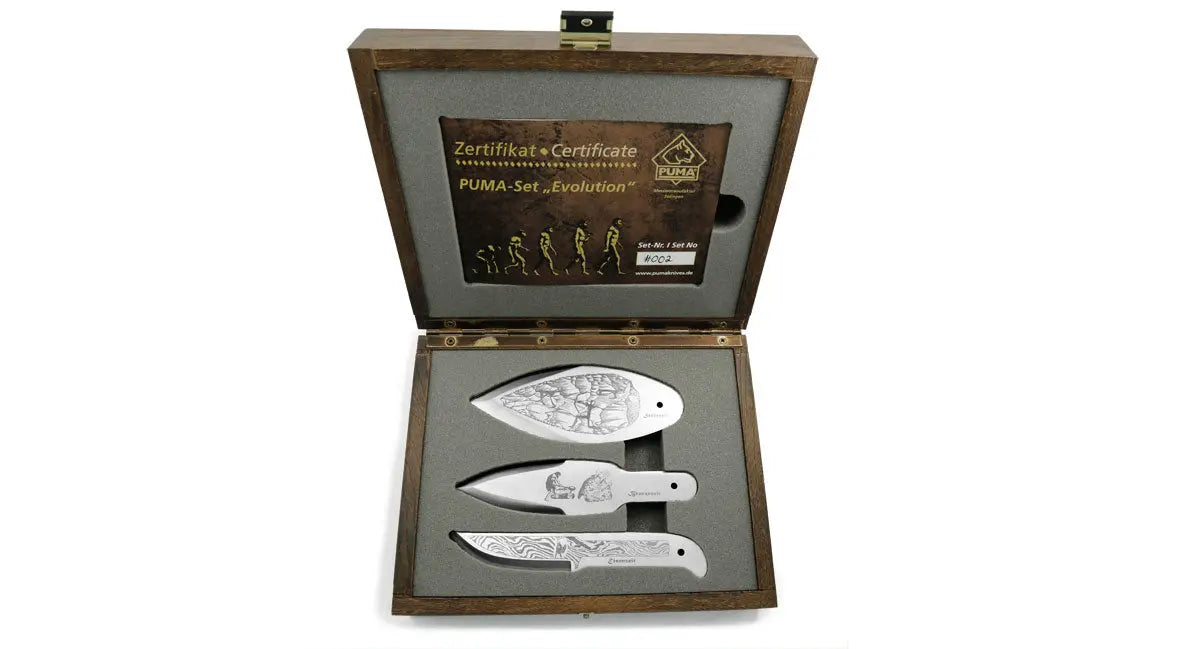
The PUMA "Evolution" set consists of three blades: Stone, Bronze, and Iron Age. Each blade has an engraving representing its respective era. The blades are packaged in a high-quality wooden box and come with a certificate. The first edition is limited to 100 pieces. Each set is numbered.
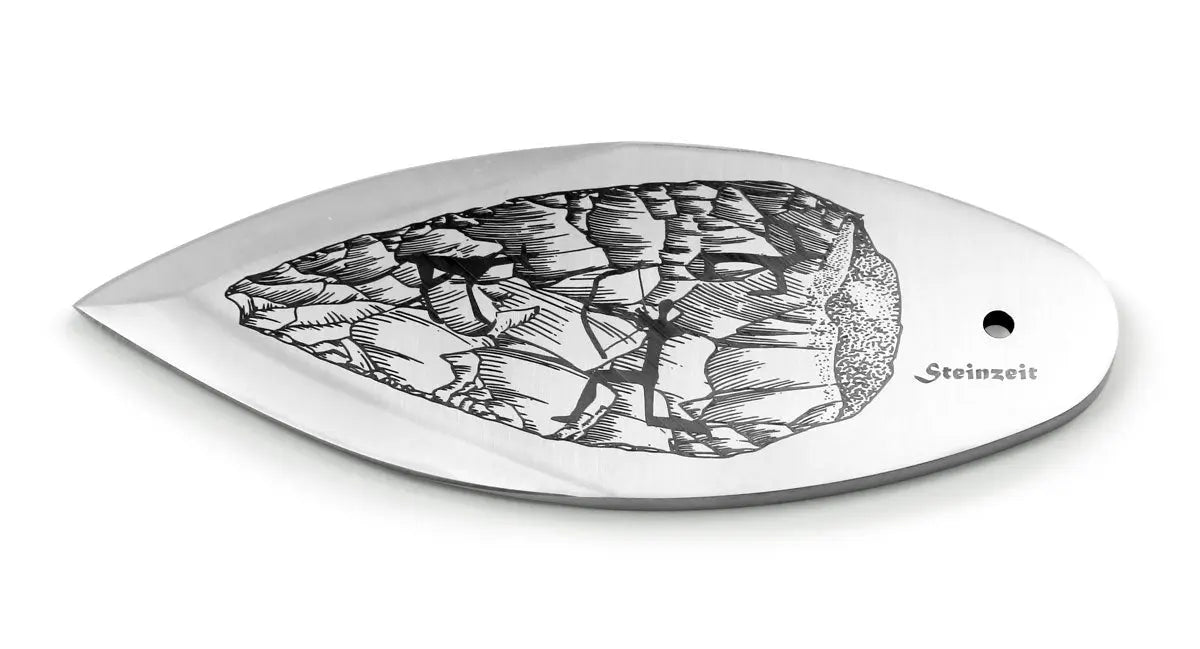
PUMA "Stone" = Hand Axe
The hand axe originated about one and a half million years ago, in the Stone Age. It was a bifacially worked and almond-shaped stone, with a pointed end opposite its rounded base. The "Stone" model is a reminiscence of humanity's first knife.
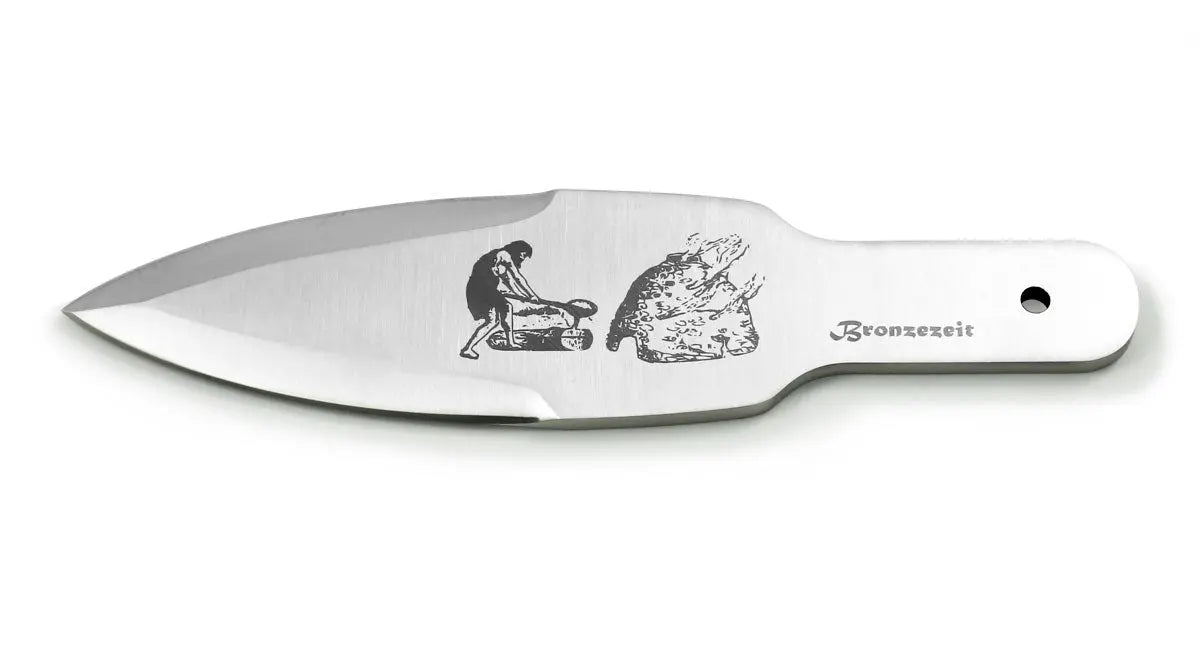
PUMA "Bronze" = Dagger with Short Handle
From the 3rd millennium BC, some peoples were able to produce cutting tools from copper. By alloying about ten percent tin, bronze metal could be cast from copper and used for knife making. The "Bronze" model is based on a dagger from this era.
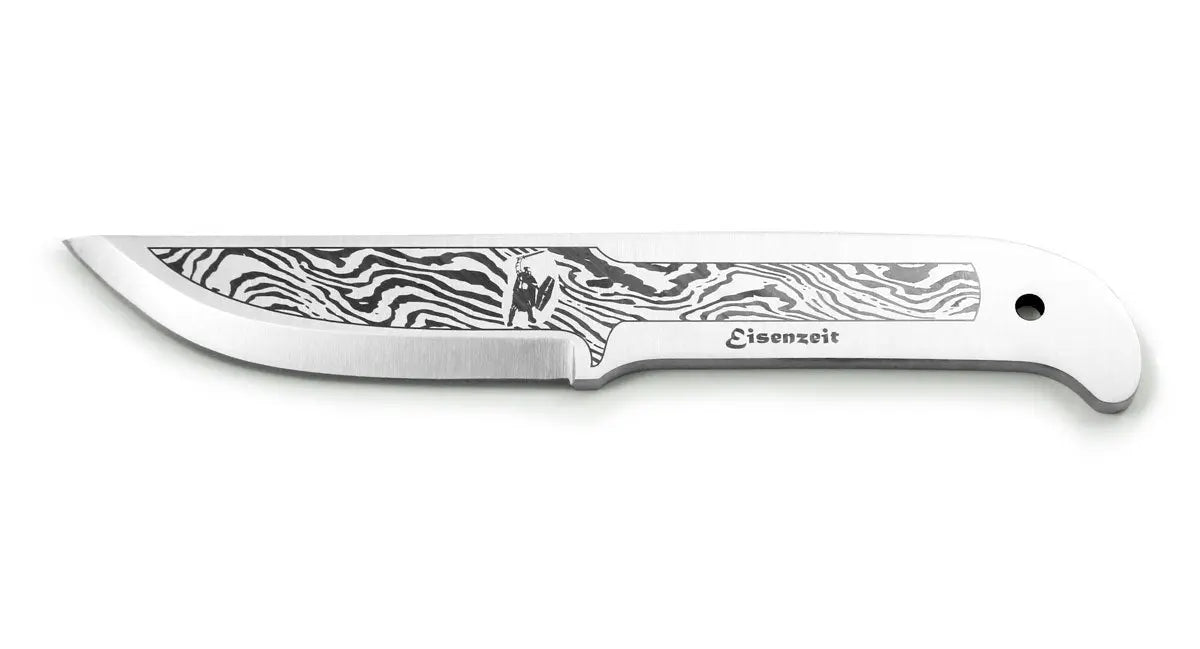
PUMA "Iron" = Knife with Long Handle
As early as the late Bronze Age, iron knives appeared, gradually replacing bronze knives. Knives produced by iron smelting are documented from the 17th century BC. This technical progress reached Europe about 2,800 years ago, marking the beginning of the local Iron Age. The "Iron" model corresponds to the design of a Celtic knife.
Details:
Stone Age
Blade edge: 55 mm (double-edged)
Overall length: 137 mm
Thickness: 4 mm
Weight: 145 g
Steel / Hardness: 1.4125 / 56-57 HRC
Bronze Age
Blade edge: 60 mm (double-edged)
Overall length: 147 mm
Thickness: 4 mm
Weight: 97 g
Steel / Hardness: 1.4125 / 56-57 HRC
Iron Age
Blade edge: 73 mm
Overall length: 153 mm
Thickness: 4 mm
Weight: 79 g
Steel / Hardness: 1.4125 / 56-57 HRC
Packaging: Wooden gift box
Dimensions: L x W x H, 220 x 176 x 72 mm
Total weight: 964 g
Design: Jörg Hübner
Technical Data & Materials
Shipping & Delivery
Shipping costs
- Germany: €4.99 – free shipping on orders over €49
- Europe: €13.99
- Switzerland: €15
- Worldwide: €29.99
- Island surcharge (abroad): €15
Delivery times
- Germany: 3–5 working days
- International: 5–8 working days
- No deliveries on Sundays and public holidays.
- For orders with different delivery times, we ship everything together – the longest delivery time applies.
Product Safety Information (GPSR)
Manufacturer:
PUMA GmbH IP Solingen
Represented by: Managing Director H. Hiepass-Aryus
An den Eichen 20–22, 42699 Solingen, Germany
Email: info@pumaknives.de
Product: PUMA "Evolution" set
Intended Use:
For hunting and outdoor use, as well as for general cutting work.
Safety instructions:
Sharp blade – risk of cuts and punctures.
Not a toy.
Use only as intended and responsibly.
Keep out of reach of children.
Use a suitable sheath for transport and storage.
Legal notice:
The distribution and use of the product are subject to the applicable legal provisions of the country.
Conformity:
The product complies with applicable EU product safety requirements.
Customers also bought
Technical details

1769
Our founding
Johann Lauterjung registers his trademark in the Solingen knifemakers' register.

1876
Production expansion
The founder's great-great-grandson is also manufacturing pocket knives, stilettos, sabers and hunting knives for the first time.

1900
Entry in the commercial register
On May 26th, the name “PUMA-Werk, Lauterjung und Sohn” will be entered into the Solingen commercial register.

1953
Puma classics are created
Production at the PUMA factory is being switched to functional hunting, fishing, leisure and sports knives.

1995
Modernization of production
New manufacturing methods, such as CNC machines and laser technology, are being promoted.

1998
Hiepass-Aryus family
Businessman H. Hiepass-Aryus takes over management and moves into the modern headquarters in the Solingen district of "Aufderhöhe".

2024
Over a quarter of a millennium PUMA
The “Solingen Knife Manufactory” has existed for 255 years – and the story continues.
1769
Our founding
Johann Lauterjung registers his trademark in the Solingen knifemakers' register.
1876
Production expansion
The founder's great-great-grandson is also manufacturing pocket knives, stilettos, sabers and hunting knives for the first time.
1900
Entry in the commercial register
On May 26th, the name “PUMA-Werk, Lauterjung und Sohn” will be entered into the Solingen commercial register.
1953
Puma classics are created
Production at the PUMA factory is being switched to functional hunting, fishing, leisure and sports knives.
1995
Modernization of production
New manufacturing methods, such as CNC machines and laser technology, are being promoted.
1998
Hiepass-Aryus family
Businessman H. Hiepass-Aryus takes over management and moves into the modern headquarters in the Solingen district of "Aufderhöhe".
2024
Over a quarter of a millennium PUMA
The “Solingen Knife Manufactory” has existed for 255 years – and the story continues.


